Free Filet Crochet Pattern Maker
Design filet crochet charts in your browser. Draw blocks and spaces on an interactive grid, get printable row-by-row instructions with stitch counts, and follow along in a hands-free Audio Mode that reads each row aloud. Free, no signup.
Unlike chart-only generators, CrochetPop writes the full row-by-row instructions with stitch counts — and reads them aloud in a hands-free Audio Mode, so you can crochet without looking at the screen. Always free, no signup.
How do you know the filet pattern is correct? Patterns are produced by deterministic algorithms and machine-validated for stitch-count accuracy — never written by a language model. Every chart you draw becomes written row-by-row instructions whose block and space counts are correct by construction — the same math a human crochet tech editor checks by hand. Unlike a chart-only generator, you leave with both the mesh chart and a followable, count-checked pattern — free, with no signup.
From a picture to real crochet
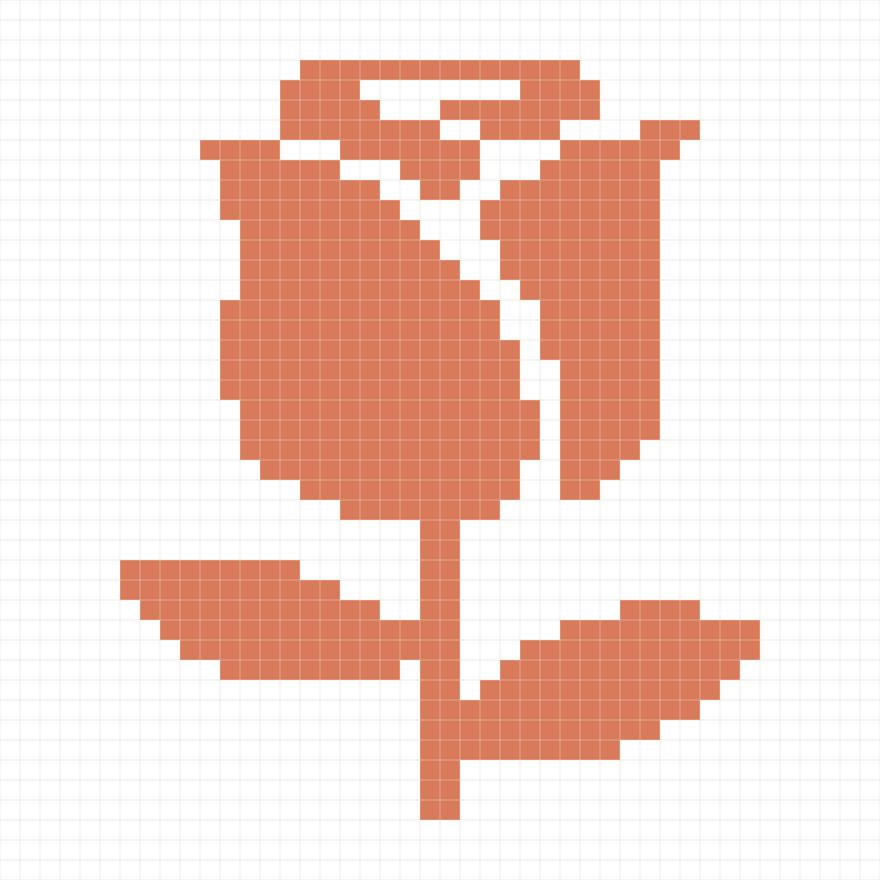
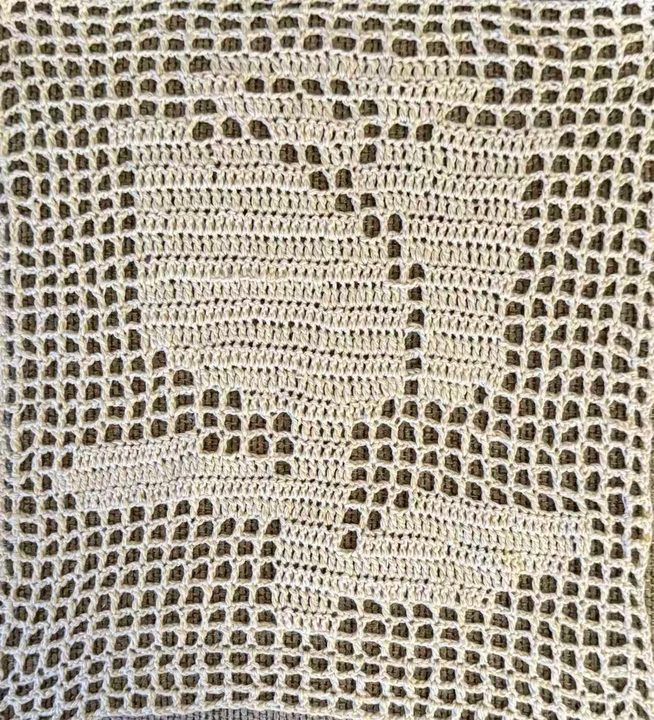
This rose started as a simple free icon. The tool charted it block-by-block into a filet pattern — then it was crocheted by hand from that chart. Same loop for your own picture or name.

How a filet crochet chart works
Filet crochet draws a picture with just two cells: the filled block and the open space, arranged on a square grid and worked flat in rows of double crochet. Neighboring cells share their boundary post, so a first filled block is 4 dc and each additional block adds 3 — 4, 7, 10 (3N+1) — while an open space is ch 2, skip 2, then the shared dc. A chart 9 cells wide always works out to 28 stitches per row — the maker states that count at the end of every row it writes.
Read the chart from the bottom up: Row 1 is the bottom row, worked right to left, and the rows above alternate direction (the arrows beside the row numbers mark it). The chart below is real output from this maker — a heart of 27 filled blocks floating on a 9 × 8 grid of open mesh.
A worked example: the filet heart
These are the actual rows the maker generates for the chart — starting from a foundation of 32 chains (9 cells × 3, plus a 5-chain rise because Row 1 opens with a space):
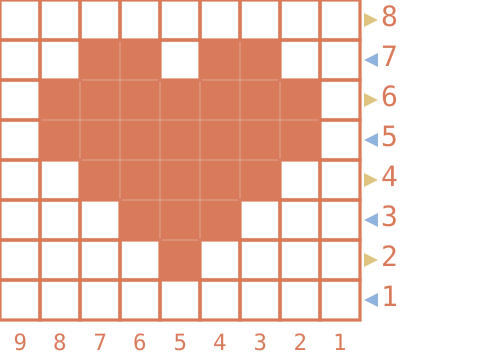
- Row 1: 1 dc in 8th ch from hook (3 ch = 1st dc, 2 ch = 1st space, sk 2 ch). (ch 2, sk 2 ch, 1 dc in next ch) × 8. (9 blocks, 28 sts)
- Row 2: Ch 5 (counts as dc + first sp). sk 2 sts, 1 dc in next st. (ch 2, sk 2 sts, 1 dc in next st) × 3. 1 dc in each of next 3 sts. (ch 2, sk 2 sts, 1 dc in next st) × 4. (28 sts)
- Row 3: Ch 5 (counts as dc + first sp). sk 2 sts, 1 dc in next st. (ch 2, sk 2 sts, 1 dc in next st) × 2. 1 dc in each of next 9 sts. (ch 2, sk 2 sts, 1 dc in next st) × 3. (28 sts)
- Row 4: Ch 5 (counts as dc + first sp). sk 2 sts, 1 dc in next st. ch 2, sk 2 sts, 1 dc in next st. 1 dc in each of next 15 sts. (ch 2, sk 2 sts, 1 dc in next st) × 2. (28 sts)
- Row 5: Ch 5 (counts as dc + first sp). sk 2 sts, 1 dc in next st. 1 dc in each of next 21 sts. ch 2, sk 2 sts, 1 dc in next st. (28 sts)
- Row 6: Ch 5 (counts as dc + first sp). sk 2 sts, 1 dc in next st. 1 dc in each of next 21 sts. ch 2, sk 2 sts, 1 dc in next st. (28 sts)
- Row 7: Ch 5 (counts as dc + first sp). sk 2 sts, 1 dc in next st. ch 2, sk 2 sts, 1 dc in next st. 1 dc in each of next 6 sts. ch 2, sk 2 sts, 1 dc in next st. 1 dc in each of next 6 sts. (ch 2, sk 2 sts, 1 dc in next st) × 2. (28 sts)
- Row 8: Ch 5 (counts as dc + first sp). sk 2 sts, 1 dc in next st. (ch 2, sk 2 sts, 1 dc in next st) × 8. (28 sts)
Open this heart in the filet maker →
Thread, yarn, and hook for filet
Traditional filet lace is worked in fine cotton crochet thread with a small steel hook, then blocked so the mesh opens into a true square grid. Modern filet works in any smooth yarn — sport or DK cotton keeps the stitches crisp enough to read the blocks at a glance. Choose a solid, light color if you want the mesh shadow-pattern to show.
A double crochet is about one and a half times taller than it is wide, so unblocked filet squares lean slightly tall at most gauges; wet-blocking pulls the mesh square. The chart always draws square cells — the published filet convention — and the fabric meets it after blocking.
Frequently Asked Questions
Does it write out the pattern, or just show a chart?
Both. Alongside the filet mesh chart, the tool writes full row-by-row instructions in words: for each row it names the turning chain, then every filled block and every open space (ch 2, skip 2, 1 dc) in order, with the running stitch count — blocks share their boundary post, so a first block is 4 dc and each additional one adds 3. Chart-only filet generators stop at the grid — here you also get a pattern you can read and crochet line by line.
How are the stitch counts checked?
Filet charts are count-correct by construction: the tool derives each row's blocks and spaces straight from your grid, so the written counts match the chart cell-for-cell. That is the same stitch-count math a human crochet tech editor checks by hand — and no language model writes the instructions.
How many chains do I start with for a filet pattern?
Chain 3 for every mesh cell of width, then add the rise for Row 1: 3 extra chains when the first cell is a filled block, 5 extra when it is an open space. The maker prints the exact foundation chain for your chart at the top of the written pattern, so you never have to compute it yourself.
Do I need crochet thread, or can I use regular yarn?
Either. Classic filet lace is worked in fine cotton thread with a steel hook, but the technique itself works at any scale — a smooth sport or DK cotton with the hook its label suggests gives a clear, readable mesh for wall hangings, curtains, and borders. The chart stays the same; only the finished size changes with your gauge. Avoid fuzzy yarns: the halo fills in the open spaces that draw the picture.
Can I make a filet chart from a photo or a name?
Yes. Upload a photo and the tool traces it into filled blocks and open spaces to build the filet mesh, or type a word or name to chart it as filet lettering. You can also draw block-by-block by hand on the grid. Everything runs in your browser — no photo is uploaded to a server.
Does it use US or UK filet crochet terms?
The written instructions use US terms: 'double crochet (dc)' is the tall post that frames each mesh square, which a UK pattern calls a 'treble (tr)'. Filet is worked identically in both dialects — only the stitch name differs. A block is a filled square and a space is an open square in both US and UK filet charts.
Is the filet pattern maker free?
Yes — completely free, with no signup and no paywalled steps. Design a filet chart, read the written instructions, print or save them, and follow along in the live row tracker without an account. There is nothing to unlock later.