Filet Crochet Patterns
Filet crochet creates images and text using a grid of open and filled squares. It uses just two stitches — double crochet (dc) and chain (ch) — making it surprisingly simple despite the impressive results. Perfect for wall art, curtains, table runners, and doilies.
Prefer to make your own instead of following a chart? Our free filet crochet pattern maker turns any image or text into a filet chart with written row-by-row instructions.
How Filet Crochet Works
- Read the chart — Filet charts are grids. Filled squares = dc stitches. Open squares = ch-2 spaces. Read bottom-up, right-to-left on odd rows, left-to-right on even rows.
- Foundation chain — chain (3 × columns), plus 3 if Row 1 starts with a block or 5 if it starts with a space (see “Starting your filet” below). Row 1 works straight off the chain — there is no separate turning chain.
- Open mesh — Dc, ch 2, skip 2, dc. Creates an empty square.
- Filled block — 3 dc past the post it shares with the square before it. Because neighbouring blocks share that boundary post, a run of blocks counts 4, 7, 10 dc for 1, 2, 3 blocks (3N+1) — not 3 dc each.
- Work flat — Turn at the end of each row. Ch 3 or ch 5 to start the next row depending on whether the first square is filled or open.
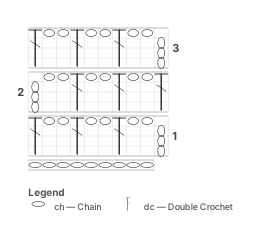
Open mesh
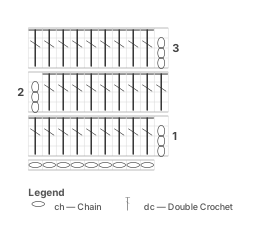
Filled block
Every filet pattern is built from just these two cells — an open mesh (ch 2, skip 2, dc) or a filled block (3 dc past the shared post: 1, 2, 3 blocks = 4, 7, 10 dc). Shown here as real stitch charts: each vertical post is a double crochet, each oval a chain — the same symbols you follow while you crochet.
Alternate those two cells row by row and you get the filet checkerboard — one written row that checkers purely by working alternate rows in opposite directions.
Rather than drawing a grid on graph paper, you can make your own filet chart in the online grid editor and get the row-by-row instructions generated for you.
Your first filet project — a 4×4 motif
You can make something real on your first attempt. This little plus-sign motif is 4 squares by 4 squares — about the size of a coaster in worsted yarn — and it uses every filet skill there is: a block, a space, a turn, and counting squares instead of stitches.
Here's a tiny 4×4 motif — the chart our engine drew, next to the exact rows it generated for it:
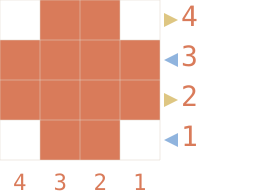
Written rows
- Row 1: 1 dc in 8th ch from hook (3 ch = 1st dc, 2 ch = 1st space, sk 2 ch). 1 dc in each of next 6 ch. ch 2, sk 2 ch, 1 dc in next ch. (4 blocks, 13 sts)
- Row 2: Ch 3 (counts as dc). 1 dc in each of next 12 sts. (13 sts)
- Row 3: Ch 3 (counts as dc). 1 dc in each of next 12 sts. (13 sts)
- Row 4: Ch 5 (counts as dc + first sp). sk 2 sts, 1 dc in next st. 1 dc in each of next 6 sts. ch 2, sk 2 sts, 1 dc in next st. (13 sts)
Chart and rows come from the exact same 4×4 grid — change one, and both update together. Every row is produced by deterministic algorithms and machine-validated for stitch-count accuracy, never written by a language model.
What people make with filet crochet
Filet is a fabric, not a project — the same block-and-space grid becomes a café curtain, a mesh top, a table runner or an edging depending only on how big you work it. Pick the thing you want and the maker opens on that fabric: with the published finished size already set where the object is one flat rectangle, and on the size picker where it is not — a bag is a tube, an edging runs to fit.
- Mesh topIn Filet Mesh (Open Mesh)20 × 24 in · about 61 sts × 48 rows in WorstedMake one
- CurtainIn Filet Mesh (Open Mesh)24 × 36 in · about 73 sts × 72 rows in WorstedMake one
- Table runnerIn Filet Mesh (Open Mesh)12 × 36 in · about 37 sts × 72 rows in WorstedMake one
- BagIn Filet Mesh (Open Mesh)No standard flat size — you pick it in the makerMake one
- BorderIn Filet Solid (Filled Block)No standard flat size — you pick it in the makerMake one
- BlanketIn Filet Solid (Filled Block)48 × 60 in · about 142 sts × 120 rows in WorstedMake one
- DishclothIn Filet Checkerboard (Blocks + Mesh)9 × 9 in · about 25 sts × 18 rows in WorstedMake one
Every size quoted here is the published finished measurement for that object, converted at worsted-weight gauge and snapped to whole squares by the same engine that writes the rows. Objects that are not one flat rectangle carry no size and open on the maker's size picker instead. Change the yarn weight or the size in the maker and every count recalculates.
How to Read a Filet Crochet Pattern and Chart
A filet chart is a grid, and every square is one mesh unit — so you can follow it square by square and it matches the written pattern exactly. There are just two kinds of square to tell apart:
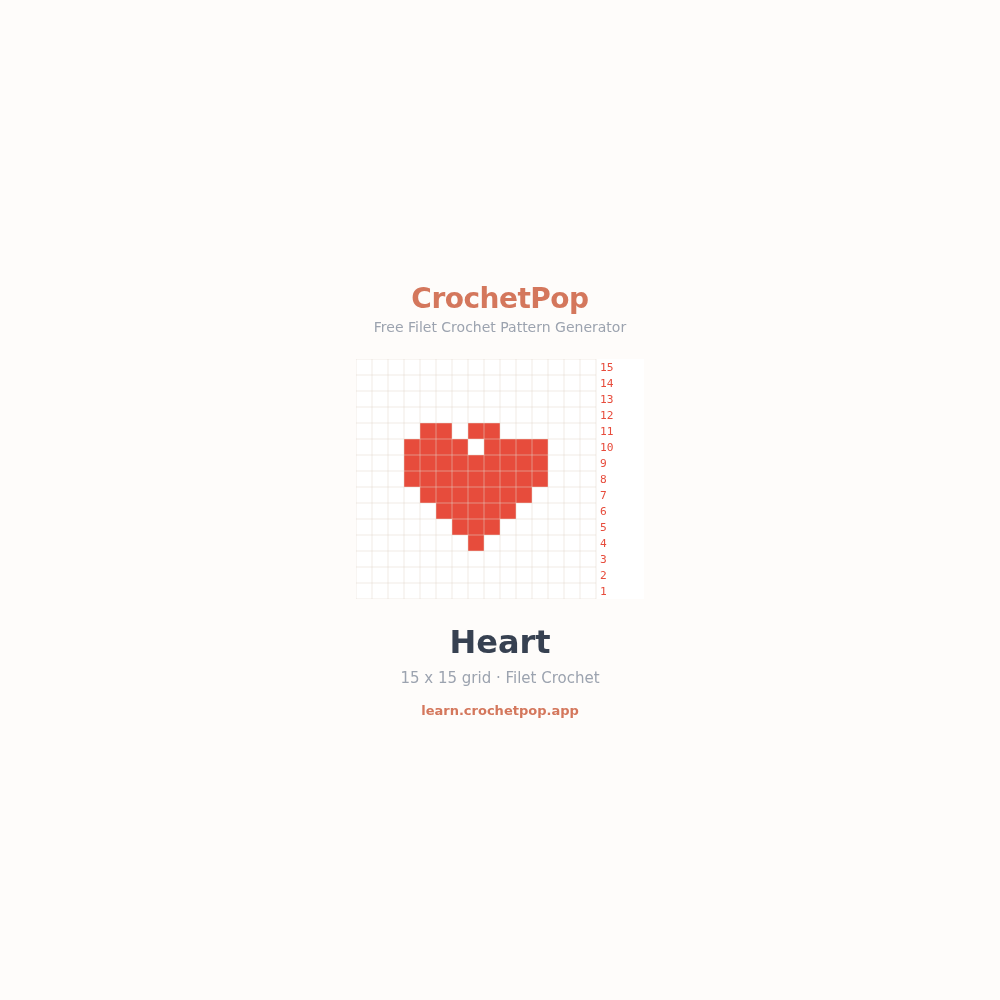
A real filet chart from our free pattern maker. Filled squares are blocks, empty squares are spaces — read it from the bottom up.
- Filled square = a block. A solid mesh unit worked as 3 double crochet (dc) past the shared boundary post — so N blocks in a row is 3N+1 dc, not 3N.
- Open square = a space. An open mesh unit worked as dc, ch 2, skip 2, dc.
Read from the bottom up. Work Row 1 right-to-left, then turn — Row 2 reads left-to-right, and you keep alternating direction all the way up, exactly how the fabric grows.
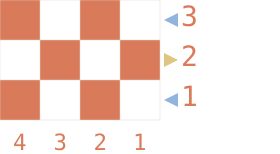
Every chart marks the direction for you. Row 1 (blue) reads right-to-left, Row 2 (gold) reads left-to-right, and rows keep alternating all the way up — exactly how the fabric grows.
Adjacent squares share the double crochet on their touching edge, so a row is not simply 3 stitches per square — count your design in squares and let the pattern maker work out the exact stitch count and turning chains.
Not a beginner? Turn any photo into a filet chart
Once the grid makes sense, you do not have to draw one square at a time. Upload a photo or type a name and the maker turns it into a filet chart with the written rows beside it — the same deterministic engine, just fed a picture instead of clicks.
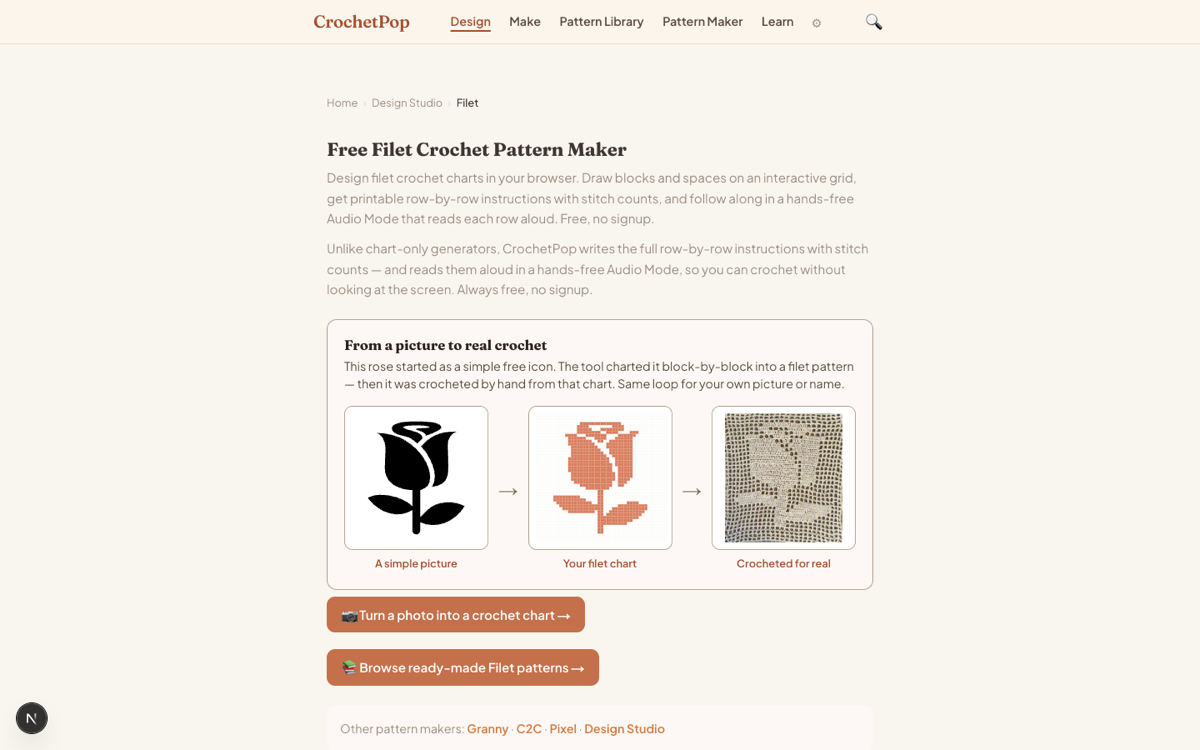
Our free filet maker, right in your browser — turn a picture into a chart, then crochet it for real.
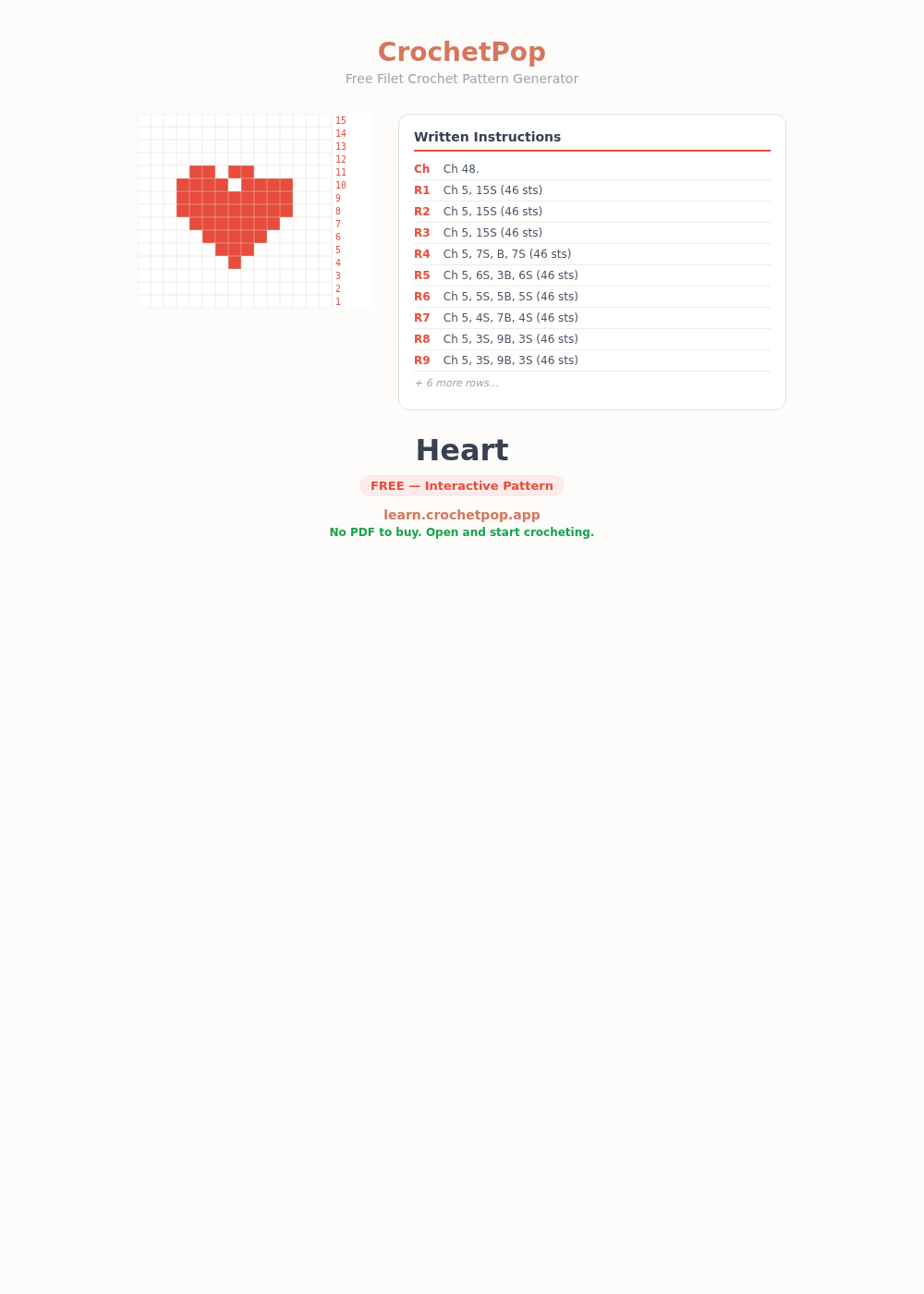
The same chart, turned into written rows — S = space, B = block. Our maker generates the chart and the instructions together, free, with no PDF to buy.
Open the free Filet Crochet Pattern Maker →
Crochet it without losing your place
A filet chart is dozens of near-identical rows, and looking away for one second costs you your place. The free row tracker keeps the chart and the written row in step: tap a row done and it advances, highlights the row you are on, and remembers where you stopped if you close the tab.
Follow along in the app: mark each row done and the chart keeps pace with you — right through to “Complete”. Free, in your browser.
Crochet it hands-free with Audio Mode
Following a chart with your hands full of yarn? In the app, Audio Mode reads your pattern one step at a time — “chain 5 … 7 spaces … 1 block” — then waits for you. Press an earbud (or tap the screen) to advance to the next step, so you crochet along without ever looking up.
Hear it — the first rows of the heart chart, exactly as Audio Mode paces them. Each click you hear is an earbud press advancing one step:
Open the filet maker and try it →Starting your filet — the foundation chain
Row 1 is worked straight into the starting chain, so there is no separate turning chain — the last few chains ARE your first stitch. How many chains you add depends on whether the row begins with a block or a space:
- Block start: chain (3 × cells) + 3. Work your first dc into the 4th chain from hook — the first 3 chains count as the first dc — then 1 dc in each chain across.
- Space start: chain (3 × cells) + 5. Work your first dc into the 8th chain from hook (3 chains = first dc, 2 chains = first space, skip 2 chains), then continue across the row.
Counting to the correct chain from the hook is the step beginners get wrong most often — count twice before that first dc. From Row 2 on, you DO turn with a ch-3 (block) or ch-5 (space) turning chain.
Try a gauge swatch first
Before starting a full project, crochet this quick 4-block swatch — the exact recipe our gauge calculator and project wizard use:

- Ch 15.
- Row 1: dc in the 4th ch from hook (the skipped chains count as your first post), then dc in each ch across, turn — 12 dc, 13 posts = 4 blocks.
- Rows 2–4: ch 3 (counts as the first dc), dc in each stitch across, turn.
Measure the swatch, then plug the numbers into our free gauge calculator to size any project correctly.
Use it in the gauge calculator →Tips for Clean Filet Crochet
- Use cotton thread (size 10) for traditional lace, or worsted yarn for wall art.
- Keep consistent tension — filet crochet shows every uneven stitch.
- Block your finished piece — steam or wet blocking makes the grid perfectly square.
- Use a smaller hook than recommended for tighter, more defined squares.
Free Filet Crochet Patterns
Generate free filet crochet patterns with interactive charts and written instructions. Choose a template or design your own in the grid editor.
A bookmark is the smallest real filet project: a strip about 7 cells wide, worked in thread. Browse the free bookmark patterns, or read how to design a crochet bookmark for the grid rules, motif placement, and the thread-versus-yarn size difference.
Get notified of new patterns
CrochetPop © 2026