How to Crochet Corner-to-Corner (C2C)
Corner-to-corner crochet — usually called C2C — is the fastest way to crochet pixel art into a finished fabric. Instead of working in rows, you work in diagonals: each square is a tiny block of double-crochet stitches, and the project grows from one corner outward to the opposite corner. C2C is the technique behind nearly every modern crochet blanket that looks like a picture, from tulips to dinosaurs to Stardew Valley scenes.
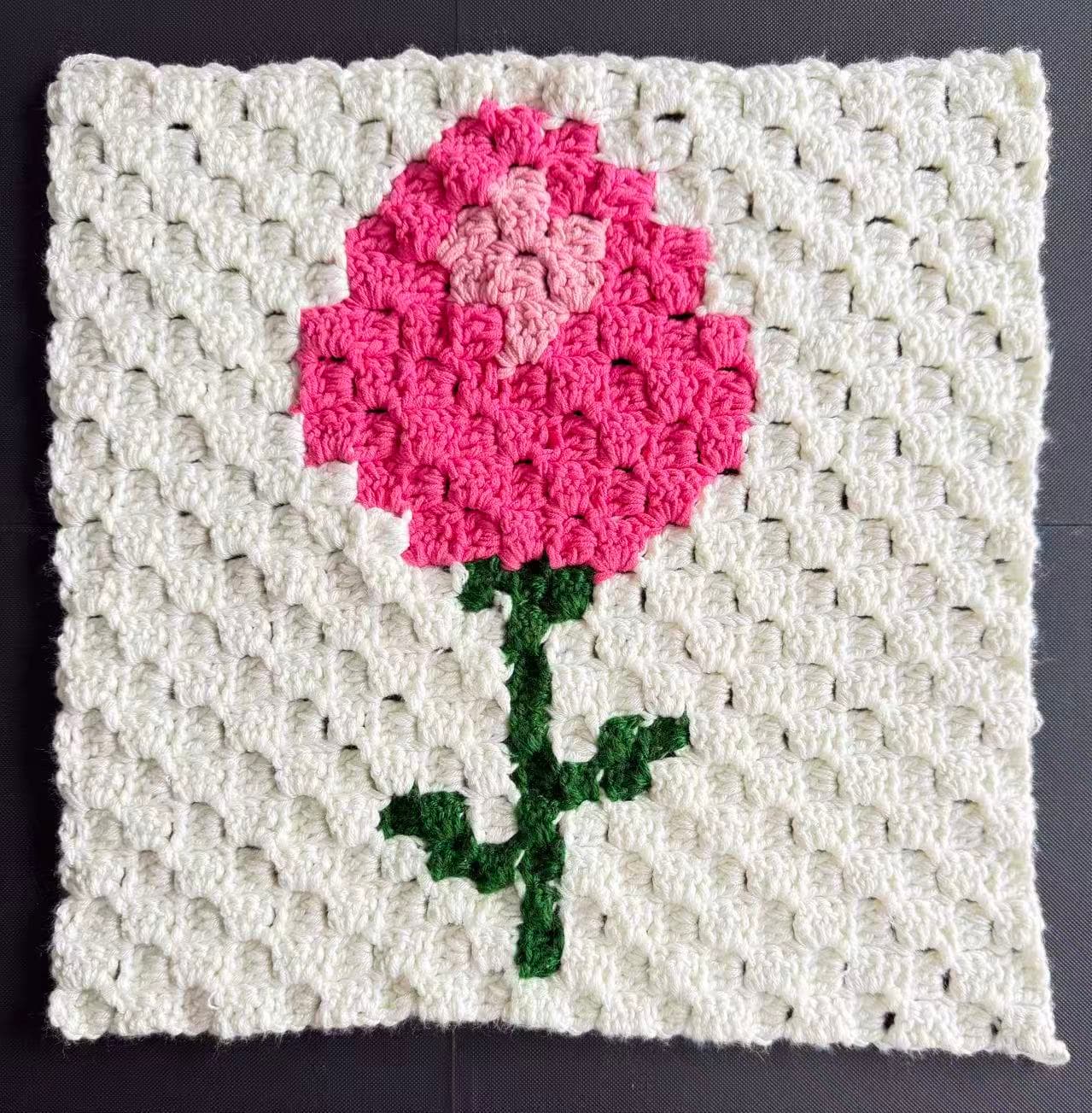
What makes C2C different
Most crochet starts at the bottom and works upward in rows. C2C starts at ONE corner and works diagonally outward — each new row is one block longer than the last until you reach the widest diagonal, then each row is one block shorter until you reach the opposite corner. The finished fabric is a square or rectangle, but the working direction is at 45 degrees.
Each block is 3 double-crochet stitches worked into a chain space, which means a 30 × 30 block square is about the size of a small lap blanket. C2C charts are read diagonally: row 1 is one block, row 2 is two blocks, row 3 is three, and so on. The chart usually shows the color of each block, and you change yarn at the start of each new color block.
What you need
- Worsted weight yarn in 2-6 colors depending on your chart. A small swatch takes about 20-40 yards per color; a full blanket needs 200-400 yards per color.
- A 5-5.5 mm crochet hook for worsted yarn. Use the hook size your yarn label recommends, going up half a size if your work feels stiff.
- A printed or digital chart with each block colored. CrochetPop's C2C charts mark increase rows and decrease rows automatically so you always know which direction you're growing.
- Yarn bobbins or small balls of each color so you can switch yarn at the start of each color block without cutting.
Round-by-round (well, diagonal-by-diagonal) steps
- Foundation: ch 6. Block 1: dc in the 4th chain from hook, dc in the next 2 chains. This is your first block — three double crochets in three different chains.
- Row 2 (increase): ch 6, turn. dc in the 4th chain from hook, dc in next 2 chains (Block 2a). Slip stitch to the top of the ch-3 at the start of Block 1, ch 3, work 3 dc into the same ch-3 space (Block 2b).
- Row 3 (still increasing): ch 6, turn. Block 3a (same as Block 2a). Then slip stitch + ch 3 + 3 dc into the next ch-3 space, repeating for each block of the previous row.
- Continue increasing every row until you reach your chart's widest diagonal. The widest diagonal is the row where you have the maximum number of blocks — for a square, this is when row count = chart width.
- Decrease rows: instead of ch 6 to start (which creates a new block), slip stitch BACK across the top of the last block, then ch 3 to begin Block 1 of the decrease row. This shrinks the row by one block.
- Change colors at the start of any block. If the next block in your chart is a different color, fasten off the old color, join the new color with a slip stitch, ch 3, and work the 3 dc as normal.
- Finish at the final block (the opposite corner from where you started). Fasten off, weave in ends, and block the fabric flat — C2C edges always have a slight diagonal lean before blocking.
Color changes in C2C
C2C is meant for colorwork — pixel art, words, pictures. There are three ways to handle multiple colors:
- Bobbins: separate small balls of each color, switched at the start of each color block. Best for charts with many color changes per row. Slower but cleaner ends.
- Carrying: leave the previous color attached and pick it up when it appears next. Good for charts where each color reappears within a few blocks. Faster but leaves yarn floats on the back.
- Stripes only: for solid-color stripes, just fasten off the old color at the end of a row and join the new color at the start. The cleanest for charts with horizontal color bands.
Tips for clean C2C
- Mark the widest diagonal on your chart with a highlighter. That's your halfway point — every row before is an increase, every row after is a decrease.
- Keep your ch-3 starting chains snug. Loose starting chains create gappy holes at the top of each block.
- Block the finished piece HARD — soak it, pin it square on a foam mat, let it dry overnight. The diagonal nature of C2C means unblocked fabric leans.
- When in doubt about direction, look at the chart's diagonal — your hook should always be moving toward the corner that has more rows to add.
Try a free C2C pattern
CrochetPop has 3 photogenic C2C patterns ready to crochet, each with a printable chart + row-by-row instructions + an interactive row tracker that follows along while you crochet.