How to Crochet a Hexagon
A granny hexagon is the six-sided cousin of the granny square and one of the most useful motifs in crochet. Hexagons tessellate cleanly without any half-pieces along the edges, which makes them a favorite for blankets, cushions, and bags. This walkthrough covers the round-by-round construction, the corner-cluster math that keeps the shape flat, and three popular variations including the African Flower hexagon.
What you need
- Worsted weight yarn in 2–5 colors depending on the variation. A full hexagon takes about 30–60 yards depending on yarn weight and number of rounds.
- A 4–5 mm crochet hook. Use the hook size your yarn label recommends, then go down half a size if the motif curls (too loose) or up half if it cups (too tight).
- Tapestry needle for weaving in color-change tails. Hexagons accumulate a lot of ends quickly — plan to weave in every color before moving to the next round.
- Stitch markers help mark the six corners on each round. Six markers (one per corner) makes counting easier as the hexagon grows.
Round-by-round steps
- Start with a magic ring. Round 1: ch 3 (counts as first dc), then work 11 more dc into the ring. Slip stitch to top of starting ch-3 to close. You should have 12 dc total — that's 2 dc per side of the eventual hexagon.
- Round 2: ch 3, dc in same stitch (counts as first corner). *ch 1, skip 1 dc, (2-dc, ch-1, 2-dc) in next dc* — repeat 5 more times for the remaining 5 corners. Slip stitch to top of starting ch-3.
- Round 3: slip stitch into the next ch-1 corner space. ch 3, (2-dc, ch-1, 3-dc) in the same corner space — this is your first corner. *ch 1, 3-dc in next ch-1 side space, ch 1, (3-dc, ch-1, 3-dc) in next corner space* — repeat 5 times. Slip stitch to top of starting ch-3.
- Round 4 and beyond: each round adds one more 3-dc cluster to each of the six sides. Corners stay (3-dc, ch-1, 3-dc); sides grow.
- Change colors at the end of any round by fastening off and joining the new color with a slip stitch into any ch-1 corner space. Always start a new color from a corner — it gives the cleanest color transition.
- Block the finished hexagon flat. Pin all six corners equidistant from the center on a blocking mat, mist with water, and let dry. A blocked hexagon tessellates cleanly with its neighbors; an unblocked one will fight you when sewing.
Tips for flat hexagons
- Count corners every round. There are always six. If you finish a round with five or seven, your hexagon will warp into a pentagon or heptagon and stop tessellating.
- Use the ch-1 corner space (not the dc on either side) when starting the next round. The chain space is where the corner increase lives.
- If your hexagon cups or ruffles, your tension is off. A cupping hexagon means too-few stitches per side; a ruffling one means too-many.
- Hexagons are easier to join with the slip-stitch-on-the-front join than the whip-stitch. The seam shows less and the corners stay sharp.
Three hexagon variations to try next
The basic granny hexagon is the foundation. Once you have it, these three variations expand what you can do with the same six-sided structure:
Classic Granny Hexagon
The standard 3-dc cluster construction described above. Looks best in 2-3 colors with each round in a different color. Forms the backbone of vintage hexagon blankets.
Start with 3 rounds for a small motif (about 4 inches), 5-6 rounds for a blanket square.
Solid Hexagon
Replace each 3-dc cluster with a continuous run of dc stitches around each side. The result is a solid fabric without the gappy granny holes — better for projects where you want a dense weave like a coaster, a placemat, or a pillow front.
Solid hexagons need one fewer dc per side than you'd think — count once and verify the corners land cleanly.
African Flower Hexagon
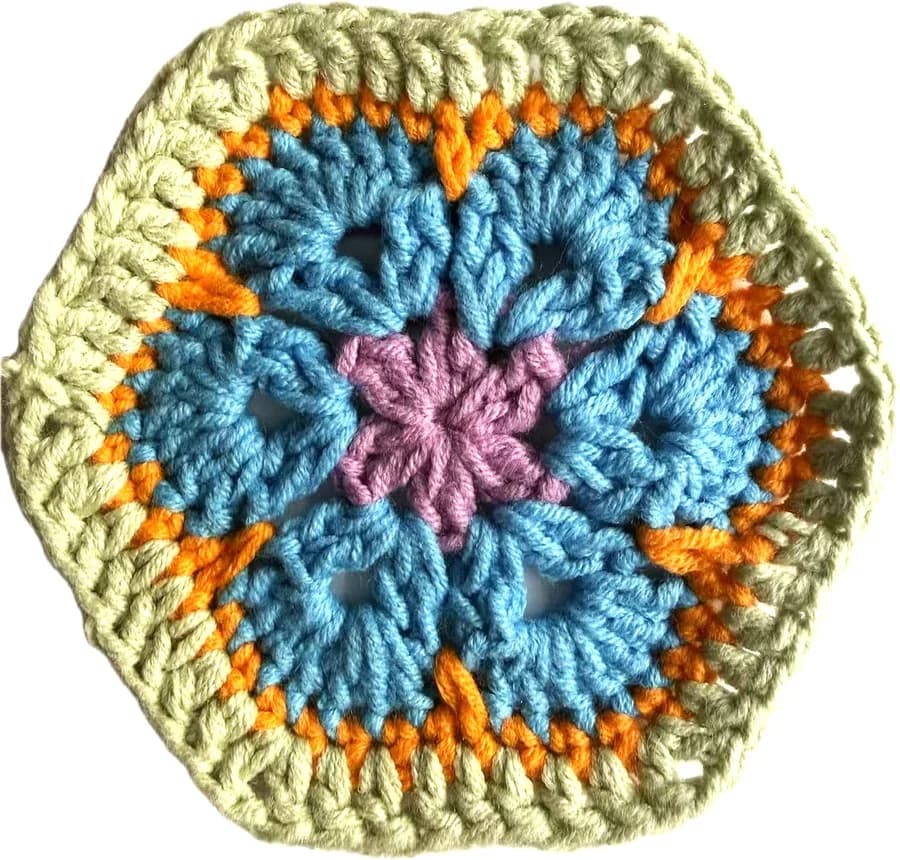
The most photogenic hexagon variation. A 5-round motif with a small flower in the center, two rounds of fanned petals, an orange or contrasting tip round, and a solid sage or border round. The classic Yarnspirations look.
Pick a color palette before starting. Five rounds means five color decisions — sketching them ahead saves rip-outs.
Generate your own hexagon
CrochetPop has interactive charts for all three hexagon variations above. Adjust the round count, colors, and stitch type, then get a printable row-by-row pattern.