Free C2C Rose Pattern — Romantic Blanket Motif
This corner-to-corner rose motif works up in red, pink, or peach yarn — a recognisable bloom in just 17×20 blocks. Beginners can finish a single panel in about 3.5 hours; combine four panels for a throw, or use one panel as a pillow cover or wall hanging. The full pattern is free, with a row-by-row chart and the Live Row Tracker for hands-free following. The rose silhouette is beautiful year-round, and it doubles as a romantic gift for occasions like Valentine's Day or anniversaries.
Open the Rose C2C Pattern + Live Row Tracker →
Full chart · row-by-row instructions · color guide · PDF export · free
Why a rose works well in C2C
The rose silhouette — a rounded bloom with overlapping petals, a narrow neck, and a branched stem — translates well to the diagonal C2C grid. The layered petal effect comes from using three related shades (mid-tone, dark shadow, light highlight) rather than one flat red. Each shade occupies a small cluster of adjacent blocks, so the colour-change frequency is manageable even for beginners.
Compared to the tulip pattern (which has clean, flat colour areas), the rose asks you to switch colours more often in the bloom section. The flower silhouette sits in rows 1–10 of the 20-row grid (with row 1 being the top edge of the chart); the stem and leaves occupy roughly rows 10–19 below it; outside the silhouette, the pattern is simple background blocks. Most makers handle the bloom section by pre-winding small bobbins for each shade instead of cutting full-length yarn strands.
Materials
- Yarn: worsted weight (CYC 4), approximately 68 yards total for the bare 17×20 motif — roughly 7 yards green (stem + leaves), 7 yards red (bloom body), 4 yards dark red (petal shadows), 3 yards pink (highlight), plus ~48 yards background if you fill the surrounding cells. Numbers are derived from the actual cell counts × 3 dc per block × 0.055 yd/dc × 1.2 buffer.
- Hook: 5 mm (US H-8), or the size needed for a firm, even C2C block
- Colors (4 for the motif itself): green (stem + leaves), red (bloom body), dark red or burgundy (petal shadows), pink (highlight/centre). Add a background color (cream, white, or any pale neutral) if you are framing the rose in a larger blanket layout.
- Notions: yarn needle, 3–4 small bobbins or butterflies for the bloom section
The Chart
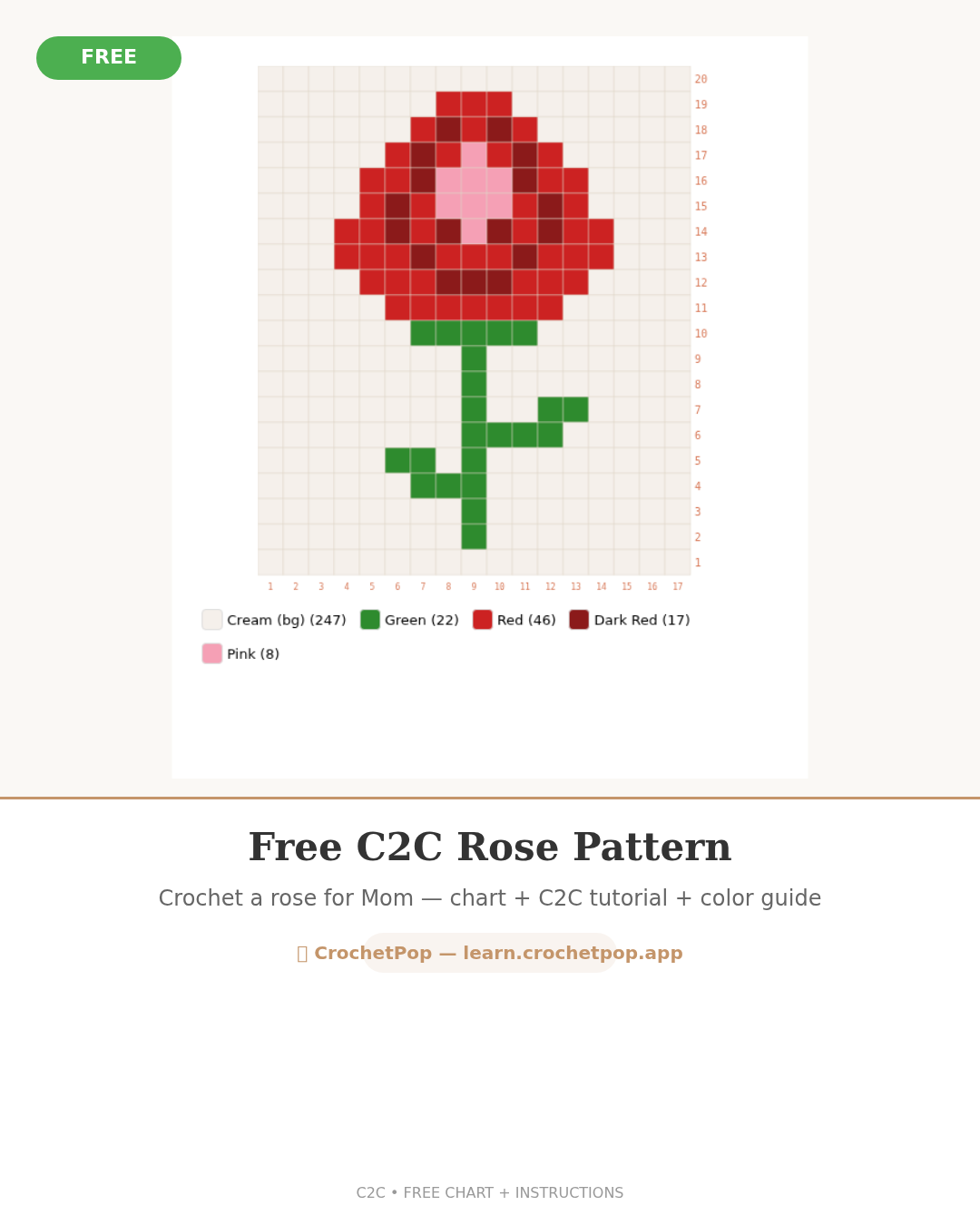
Read the chart from the bottom-right corner, working diagonally up-left. Each square = one C2C block (ch 3 + 3 dc cluster worked into the ch-3 space of the joining block). The rose bloom occupies the upper half of the 17×20 grid; the stem and leaves rise from the lower half; background blocks fill the rest.
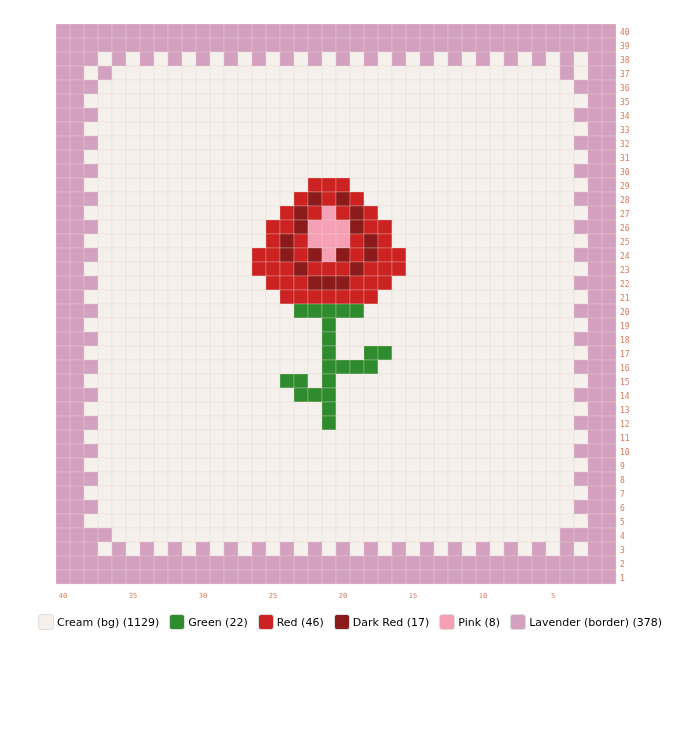
The full interactive chart with diagonal row numbers and colour key lives on the pattern page. The chart recalculates when you adjust finished size or swap yarn weight. At worsted-weight gauge (1.25 blocks per inch per CrochetPop's gauge table), the bare 17×20 motif works up at roughly 13.6 × 16 inches.
Step-by-step walkthrough
C2C alternates direction each row: odd diagonal rows go right-to-left; even rows go left-to-right. Each increase row adds one block at the starting corner; each decrease row drops one at the end.
- Foundation: Ch 6. Dc in 4th, 5th, 6th ch from hook (= 1 block, background colour).
- Increase phase: At the start of each row, ch 6, dc in 4th–6th ch for a new block; work across joining each block into the previous row's ch-3 spaces. The grid is 17 wide × 20 tall, so the short axis (17) reaches its maximum before the long axis (20). Keep increasing on the long edge until you reach 20 diagonal rows on that side.
- Decrease phase: Once the long edge has reached its maximum, stop starting new blocks on that side — just join into the first ch-3 space and work across normally. Each row ends one block shorter.
- Colour changes: Drop the old colour at the last "yo, pull through" of the last dc in the current block. Pick up the new colour for the ch-3 that starts the next block.
- Bloom section: Use separate bobbins for the dark-red shadow clusters and the pink highlight clusters. Carry the main red along the back of adjacent background blocks to avoid too many cut ends.
New to C2C? The filet crochet guide covers grid-reading fundamentals that apply here, and the Live Row Tracker article explains exactly how the tracker labels diagonal rows and handles colour changes.
Colour-changing tips for the rose
- The dark red shadow creates petal depth — don't skip it. A flat single-red rose looks like a circle; the shadow shaping makes it look like an actual bloom with layered petals. The dark-red cluster is only ~21 cells, so you only need a small bobbin (~4 yards).
- The pink highlight in the centre is just ~17 cells. Wind a small bobbin (~3 yards) and use only for that cluster — don't cut a full skein.
- All the green (stem + leaves) can be worked from the same ball. The stem is a narrow column of blocks running from the bottom-center to the bloom; carry the green yarn up the side of background blocks rather than cutting between leaf sections.
- The background is a continuous strand — just pick it up and put it down as you work across non-background blocks. No need for a separate bobbin.
Using the Live Row Tracker
The rose bloom section is where most makers lose count — the colour-change density is highest here, and it's easy to mix up which shade goes in which block. The Live Row Tracker shows you the colour map for the current diagonal row so you can see exactly which blocks are dark-red, which are pink, and which are red before you pick up your hook.
Open the Rose C2C pattern page and click the orange Open Live Row Tracker button. The tracker opens with every diagonal row of the 17×20 motif pre-loaded. Mark each row done as you finish it; undo if you tapped early. The tracker auto-saves, so closing the browser won't lose your place.
For a full explanation of the tracker's features — including how to import external patterns — read Live Row Tracker — Never Lose Your Place in a Crochet Pattern.
What you can make with this panel
- Single panel wall hanging — finish with a 2-round sc border, slip a dowel through the top row, add hanging twine
- Pillow cover (roughly 14×16 in) — make a second plain-coloured panel or a fabric backing; seam three sides, insert a pillow form, seam closed
- Four-panel throw (roughly 28×32 in plus border) — join four identical panels with a JAYG (join-as-you-go) flat stitch or single-crochet seam. Add a 3-round border to unify the edges.
- Baby blanket centerpiece — drop the motif into the Blanket Designer's center-1×1 layout on a baby (30×36 inch) size, then add a 2-round single-crochet border
- Tote bag panel — sew onto a canvas tote with a running whip stitch; the 17×20 panel fits most standard tote front panels
- Framed fibre art — stretch and pin to a corkboard or foam core; hang unframed as a textile print
Colour variations
The rose silhouette reads clearly in nearly any palette. Swap the four motif colours as a unit (plus optional background) to change the mood completely. These are ideas — preview each in the Design Studio before buying yarn:
- Classic red — green stem, true red bloom, dark crimson shadow, blush pink highlight, cream background. The original — high contrast, unmistakably a rose.
- Dusty pink — sage green stem, dusty rose bloom, wine shadow, pale ivory highlight, white background. Softer and vintage-feeling.
- Yellow rose — olive green stem, golden yellow bloom, warm amber shadow, pale cream-yellow highlight, white background.
- White rose — forest green stem, white bloom, light grey shadow, very pale yellow highlight, grey background. Elegant and minimal.
- Peach rose — sage green stem, warm peach bloom, deep coral shadow, blush ivory highlight, cream background.
Use the Design Studio to preview any palette before buying yarn — load the rose grid, swap the colours live, and the chart updates instantly. You can export the new colour guide as a PDF.
Seasonal gift ideas
A handmade crochet rose panel is a strong gift choice for occasions that call for romance or gratitude. Mother's Day, Valentine's Day, and anniversaries all work well. A completed 17×20 panel with a clean sc border and wooden dowel takes an hour to finish into a wall hanging; a matching envelope pillow (two panels + insert) is a weekend project at a relaxed pace. Tag #crochetpop if you share it online.
More free C2C and grid patterns
- Free C2C Tulip pattern — simpler colour areas, 3 colours, great first C2C project
- Free C2C Sunflower pattern — bright yellow + brown centre, 3 colours, high contrast
- Best free crochet pattern generators 2026 — honest side-by-side comparison of 5 tools
- Photo to crochet pattern — upload any image and get a C2C or SC pixel chart automatically
- Filet crochet guide — grid-based crochet fundamentals that underpin all C2C charts
- Live Row Tracker — track any pattern row by row, including ones from external sources